
The test
We wanted one variable and nothing else, so the setup was built to remove every other difference between the two receivers.
- Receivers: two identical, golden-reference GPS receivers running the same firmware version.
- Signal: one antenna feeding both units through a power splitter. Cable loss was matched to within 0.5 dB, so both units received exactly the same satellites at exactly the same strength.
- Power: both units ran from the same noisy source, a standard 5 V USB port.
- Control unit: powered by low-dropout linear regulators (LDOs), the industry’s best practice for noise-sensitive GPS.
- Test unit: powered through TransSiP PI.
- Duration: both units sat stationary and logged a position once a second for 24 hours, under weak signal conditions.
What happened
Under weak signals, the LDO-powered control unit made position errors of up to 2.5 km. That is about as long as the airport runway visible on the map plot. Under the same conditions, the TransSiP PI unit’s errors stayed at about 200 m, which is ten times smaller.
The signal-strength histograms were the same for both units, as they should be with one shared antenna. The control unit’s histogram, however, showed many more dropouts. The PI-powered unit held its lock on the same weak signals.
Why a GNSS receiver hears its own supply
GNSS signals arrive below the thermal noise floor. The GPS interface specification puts the minimum received L1 C/A power at −158.5 dBW, or −128.5 dBm. Thermal noise in a 2 MHz bandwidth is about −111 dBm:
−174 dBm/Hz + 10·log10(2 × 10⁶ Hz) ≈ −111 dBm
So even an unobstructed satellite arrives about 17 dB below the noise, and the receiver pulls it out with correlation gain. Small antennas, buildings, trees and multipath push the signal lower still. In that regime every noise source inside the receiver competes with the satellites. Supply noise reaches the LNA bias, the synthesizer and the reference oscillator. On an oscillator it shows up as phase noise and frequency pushing, and the tracking loops have to treat it as signal dynamics.
TransSiP first identified Switching Noise Jitter while investigating exactly this kind of instability in GPS systems. SNJ is switching noise whose phase moves in time. It is the dominant noise under weak signal conditions, and it is hard to see with conventional frequency-domain analysis. An LDO does not fix it, because its rejection falls off at high frequency and it does nothing about noise generated on the load side.
Time to first fix is an energy problem
The most power-hungry thing a GNSS receiver does is find its first position. The acquisition phase uses 5 to 10 times the power of steady navigation, and under weak real-world signals a time to first fix of one or two minutes is common. A cleaner supply shortens that phase. The receiver spends less time re-acquiring and less energy on digital processing.
In a side-by-side demonstration, a GPS sports watch fitted with a TransSiP PI-enabled supply reached its fix faster than an unmodified watch. That made 5× more battery life possible.
A watch that never needs charging
In February 2019, u-blox, MATRIX Industries and TransSiP announced the PowerWatch 2. It was the first GPS smartwatch you never need to recharge. Body heat and sunlight top up its battery.
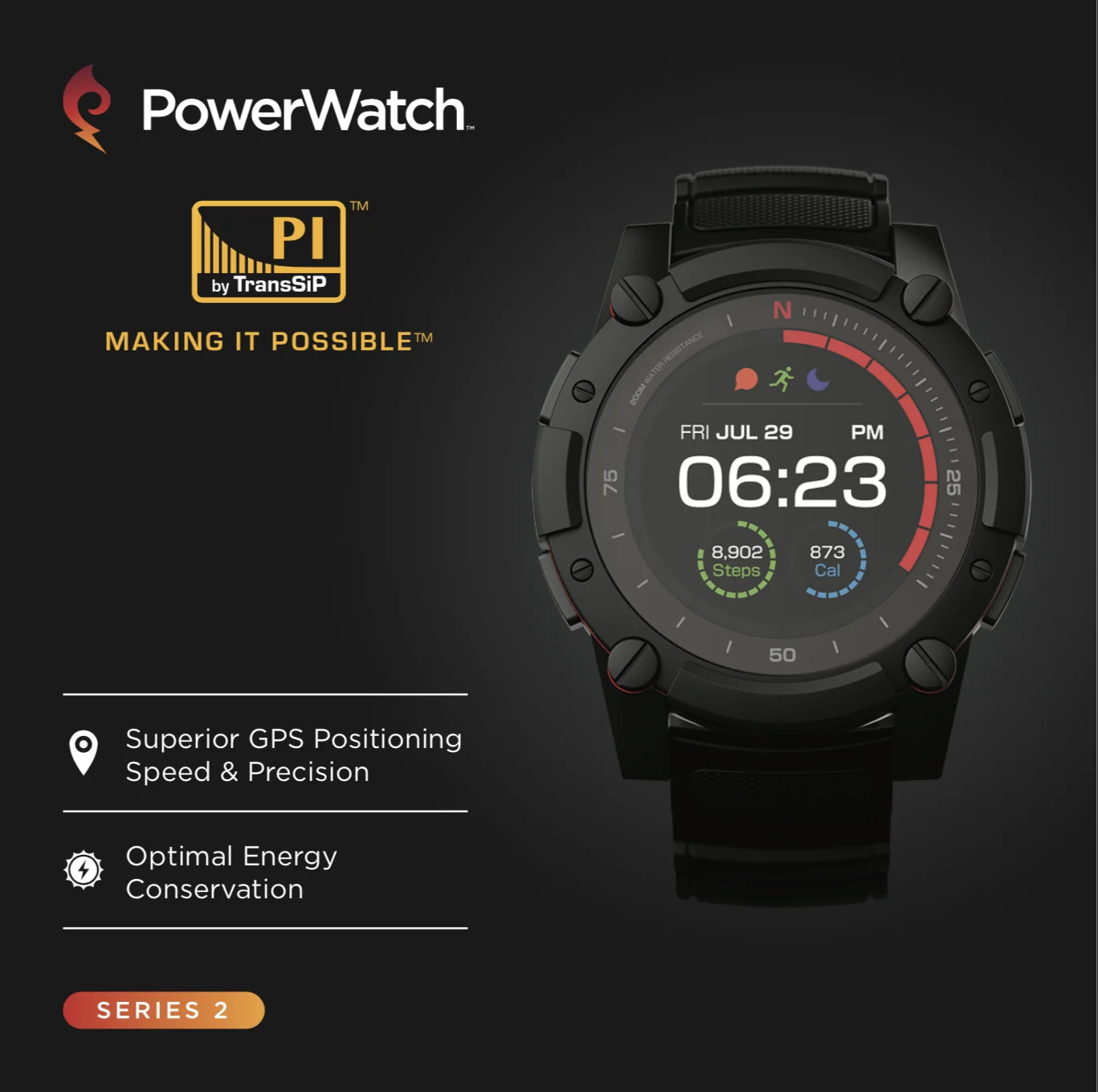
The watch tracks position with the u-blox ZOE-M8B, a 4.5 × 4.5 × 1.0 mm System-in-Package GNSS receiver that can consume as little as 12 mW. Even so, the energy budget is tight. The watch supports 30 minutes of continuous GNSS tracking per day, and unused time accumulates. TransSiP PI converts the harvested energy efficiently and delivers a very quiet DC supply, which lets the receiver balance power against performance.
“TransSiP PI makes it possible to deliver high performance and high efficiency simultaneously by reducing system noise, eliminating time spent re-acquiring data, and minimizing the need for additional processing.” Douglas Tham, CTO, MATRIX Industries
“The combination of TransSiP PI and the ZOE-M8B solved all of these pain points for us, enabling the watch to quickly lock in on its position even in weak signal environments.” Akram Boukai, CEO and co-founder, MATRIX Industries
Applying it to your receiver
- Filter the rails that listen. Put Harmony on the supplies that feed the GNSS module or LNA, the TCXO and the synthesizer. Keep the noise generators, such as the PA, the processor and busy I/O, on the other side of the filter.
- One part for every rail. The TSNJ-5A6L26 handles up to 5 A, so the same Type-B circuit covers low-current RF and oscillator rails and shared rails alike.
- Test the way the field fails. Strong-signal C/N0 can look identical on two receivers that behave very differently under trees. Use a splitter, matched cables, the same firmware and a 24-hour log, then compare position scatter and dropouts.
Sources
- TransSiP PI: power integrity technology gives 10× smaller positioning errors in GPS (video and transcript)
- TransSiP PI enabled 5× more battery life (video)
- TransSiP, GNSS benefits
- u-blox press release, 12 February 2019: MATRIX Industries’ pioneering no-charge GNSS smartwatch has u-blox and TransSiP PI technology under the lid
- GPS.gov, Interface Control Documents and Interface Specifications (IS-GPS-200, minimum received L1 C/A power)